
 10.12.2025
Power to the People: Understanding Switzerland’s Direct Democracy
Switzerland’s political system is famous for its direct democracy, a framework in which citizens routinely vote on laws and policies themselves, rather than leaving all decisions to elected representatives. It sounds almost utopian – a political system where the people have the power, not the politicians – yet for the Swiss it’s simply a way of life.
If you’re an expat in Switzerland, you’ll soon notice that voting is a frequent national pastime, with polls opening every few months on issues ranging from taxes and immigration to the minute detail of whether cows should be allowed to keep their horns.
This editorial guide will explain how Swiss direct democracy works, who gets to vote (and who doesn’t), and what it all means for civic life and for foreigners making Switzerland their home.

Main image: Louis via Pexels.com
Frequent Votes on Big and Small Issues
Unlike many countries where nationwide referendums are rare events, Switzerland holds national votes roughly four times a year on a broad array of topics. These “votations” can cover anything from major national policies to everyday questions – in recent years, citizens have voted on tax reforms, immigration rules, shop opening hours, environmental laws, and even whether or not to ban the construction of new minarets. No issue is too big or too small to be put to a direct popular vote.
On Swiss voting Sundays, a citizen might find several ballot questions in their mailbox or polling place at once: some at the federal (national) level, others at the cantonal (regional) or local community level. The system of referendums and initiatives exists at all levels of government – local communes and cantons have their own direct votes on local matters, following similar rules to the national votes. This means Swiss people regularly decide not just who will represent them, but what laws will govern them in their municipality, their canton, and the country as a whole.
Another striking aspect for newcomers is how routine and normalised this process is in Swiss life. Votes are scheduled so frequently that most Swiss have participated in dozens of referendums by the time they reach middle age. Voting is not legally required – there is no compulsory voting – yet turnout remains relatively healthy, usually around 50% of eligible voters for an average issue. For especially significant questions, participation can surge: the record turnout was nearly 79% in 1992, for a referendum on joining the European Economic Area.
This regular rhythm of voting fosters an engaged citizenry. Everyone knows another vote is always around the corner, so political questions become an ongoing public conversation rather than a once-in-a-decade event. Campaign posters pepper Swiss cities throughout the year, communal discussions and debates are commonplace, and the local media provide exhaustive coverage of each proposal. It’s a far cry from countries where politics heats up only at election time – in Switzerland, direct democracy makes political decision-making a continuous civic affair.
Referendums vs. Popular Initiatives: Two Paths to the Ballot
There are two main instruments of nationwide direct democracy: referendums and popular initiatives. Both lead to a yes/no vote of the people, but they enter the political process at different stages.
Referendum (Veto) – A referendum is typically a vote on a law or decision that has already been passed by the parliament. It is essentially a people’s veto. Some referendums are mandatory – for example, any amendment to the national constitution or a decision to join an important international organisation must automatically be put to a popular vote. Other laws are subject to an optional referendum, triggered only if enough citizens call for it. The bar to trigger an optional referendum is 50,000 signatures from eligible voters within 100 days of the law’s passage. If the signature campaign succeeds, the law is frozen until a nationwide vote is held. A simple majority of voters can overturn or uphold the law. This gives Swiss citizens a powerful check on their lawmakers. About half of optional referendums historically result in the people rejecting the parliament’s decision.
Popular Initiative (Proposal) – The initiative is the mirror image of the referendum: instead of reacting to a law, citizens take the initiative to propose a change. This typically involves a constitutional amendment. To launch an initiative, organisers must collect 100,000 signatures from Swiss voters within 18 months. If successful, the proposal is put to a nationwide vote. Initiatives can be about almost anything within federal authority – from universal basic income to animal rights. The scope is broad, and any citizen group can start an initiative. Some of the country’s most notable changes have come from initiatives – such as recognising Swiss National Day as a public holiday or joining the United Nations.
Not every idea becomes law even if approved. Major changes require a double majority: a majority of voters nationwide and a majority of Switzerland’s cantons must approve the proposal. When an initiative passes, it instructs the parliament to implement the idea, which can lead to further debate on how the policy is executed. Because any new law can also be challenged by referendum, there is a moderating effect: parliament must craft implementation carefully to avoid another public veto. Direct democracy in Switzerland is direct, but also deliberative and slow-moving.
 Element5 Digital via Pexels.com
Who Can Vote in Switzerland?
Voting rights in Switzerland are tightly linked to citizenship. At the federal level, only Swiss citizens aged 18 or over are entitled to vote or stand for election. This means that the roughly 25% of Switzerland’s residents who are foreign nationals have no vote on national issues or in national elections.
There are some exceptions at the local level. Switzerland’s 26 cantons determine their own rules for cantonal and municipal voting rights. Two cantons – Neuchâtel and Jura – allow non-citizens to vote in cantonal elections and referendums under certain residency conditions. At the municipal level, several cantons entitle foreign residents to vote in local elections and issues after they have resided in the area for a set number of years. In some of these communities, foreigners can even be elected to local office. Still, the majority of Switzerland’s foreign population remains politically voiceless, especially at the national level.
For Swiss citizens, voting is a right but not an obligation. Participation rates usually hover around 40–60% for most national ballots. Voter fatigue can occur, but the high frequency of votes normalises the act of voting. Before each vote, every household receives an official booklet explaining the proposals in detail, including arguments from both the “Yes” and “No” camps. This helps voters navigate complex issues.
Life Under Direct Democracy: Civic Culture and Participation
Direct democracy fosters a remarkable degree of grassroots involvement and political awareness. Ordinary citizens become key players in the political process. For any referendum or initiative to happen, thousands must engage – to sign petitions, collect signatures, and campaign. Swiss civil society is very active.
Because any citizen could, in theory, launch or halt legislation, there’s a sense of collective responsibility. Even those who don’t vote know they had the opportunity. Swiss politicians, for their part, must govern with an ear to the ground. Knowing that their constituents can challenge any law, lawmakers tend to seek broad consensus. Switzerland’s Federal Council is a power-sharing executive body drawn from multiple parties, and no single party ever holds an outright majority in parliament. Compromise is the norm.
Referendum and initiative campaigns do not always follow party lines. Public debate is often issue-focused rather than strictly partisan. The need to win a majority of voters – and sometimes a majority of cantons – forces campaigners to reach beyond their base. Most initiatives fail at the ballot box, but even failed votes can have an impact by raising awareness or sparking national debate.
There are, however, challenges. Change can be slow – women didn’t gain the right to vote at the federal level until 1971, partly because male voters repeatedly rejected it in referendums. Direct votes have also produced controversial outcomes, such as banning the construction of new minarets. Complex issues are sometimes reduced to simplistic choices, and campaign funding remains opaque, with little transparency about who finances referendum campaigns.
Despite these concerns, Switzerland remains politically stable. Governments do not collapse over referendum results, and the Federal Council carries on regardless. The system’s clarity and frequency of voting help prevent crises and enable political course correction without upheaval.
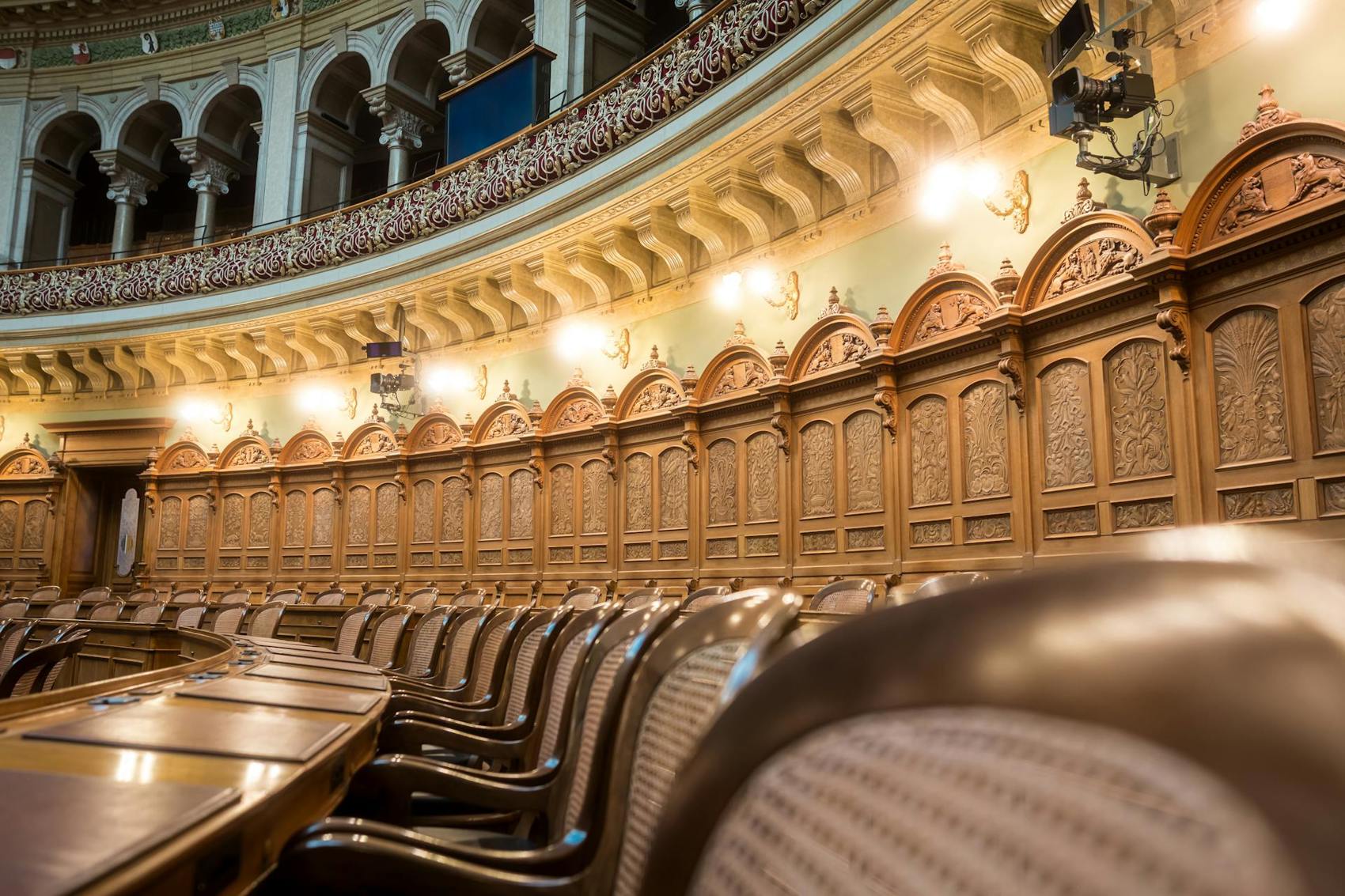 Swiss Parliament Council Chamber in Bern. Christian Wasserfallen via Pexels.com
Foreigners on the Sidelines: Taxation, Participation, and Integration
With roughly one in four residents being foreign nationals, Switzerland has one of the highest proportions of non-citizens in any Western democracy. Most of these foreigners don’t have a say in the laws that govern them. They pay taxes, follow Swiss laws, and contribute to their communities, yet have no direct political voice.
This exclusion can hamper integration. Voting is not only about having a say; it also signals belonging. Some long-term residents describe it as taxation without representation. Swiss naturalisation is possible, but demanding. It usually requires at least 10 years of residency, local language proficiency, and evidence of integration. In some communes, even gaining citizenship involves a local vote.
Despite these hurdles, many expats do naturalise and fully join the political process. Others remain engaged informally – attending town halls, joining civic organisations, or following political debates closely. Some municipalities have advisory councils for foreign residents. In a few cantons, foreigners can vote in local elections. Still, for most, becoming Swiss remains the gateway to political rights.
Debates are ongoing about easing access to citizenship or granting broader voting rights to foreigners. As the foreign community grows, there is increasing pressure to adapt the democratic system to be more inclusive.
Final Thoughts
For newcomers to Switzerland, direct democracy can take some getting used to. It demands more from voters than just turning up every few years. But it also gives more in return: a sense of agency and shared responsibility.
Even if you can’t vote yet, it’s worth following the campaigns and debates. They offer a window into Swiss values and civic life. You may find yourself signing petitions, volunteering for causes, or even applying for citizenship to become an active participant.
Direct democracy isn’t perfect. But in Switzerland, it works – not because it’s fast or simple, but because it’s deeply embedded in the culture. Citizens accept both the power and the consequences of their choices. And that trust in the people, tested week after week, vote after vote, remains one of the country’s defining strengths.
Podcast episode
For more on these topics, please be sure to listen to this episode of our Living in Switzerland podcast.
Direct Democracy in Switzerland - how does it work?
If there are any other topics you’d like us to cover, please email us at contact@rigby.ch to let us know.
Sources
Swiss Government and Legal Framework
Swiss Confederation official portal (information on referendums and initiatives)
Swiss Parliament
Foreigners and voting rights
Women’s suffrage in Switzerland
Minaret ban referendum coverage
Direct democracy overview
Rights of Swiss citizens and non-citizens regarding voting at federal, cantonal, and municipal levels
Alliance for transparency in Swiss politics (lobbying and campaign finance)