
 19.03.2026
The Story of Switzerland: History, Identity, and Its Place in Europe
A Small Country with a Remarkable Story
The story of Switzerland is one of quiet resilience and careful balance. Nestled among the Alps, this small nation has spent centuries navigating powerful neighbours, internal divisions, and sweeping European change—yet it has consistently maintained its independence, stability, and unique identity.
From medieval alliances forged for survival to modern agreements with the European Union, the Swiss Confederation offers a fascinating example of how pragmatism, cooperation, and neutrality can shape a nation’s long-term success.
For those living in or considering a move to Switzerland, this history is not just background—it is reflected in everyday life. The country’s strong institutions, emphasis on local decision-making, and culture of compromise all have deep historical roots that continue to influence how Swiss society functions today.

Main image: Evelin Magnus via Pexels.com
A Tradition of Balance and Independence
The historical evolution of the Swiss Confederation stands as a compelling case study in decentralized governance and strategic neutrality. Spanning more than seven centuries, Switzerland’s development reflects a blend of mythic origins and practical legal structures. From the defensive pacts of Alpine valleys in the late thirteenth century to its modern institutional ties with the European Union, the country has continually balanced local autonomy with external pressures.
This balancing act is visible in modern Switzerland’s political system. Decisions are often made through referendums, and citizens play a direct role in shaping policy. The emphasis on consensus rather than confrontation reflects a long tradition of negotiation and shared responsibility.
Geography and Early Foundations
The foundations of Swiss history are deeply tied to its geography. The Alpine region both isolated communities and connected them through vital trade routes. Archaeological evidence shows human habitation dating back to prehistoric times, with early trails crossing mountain passes. By the first century BC, the Helvetians, a Celtic people, dominated the Swiss Plateau. Their encounter with the expanding Roman Empire led to incorporation into Roman territory, where the region—known as Helvetia—benefited from infrastructure, trade, and urban development.
Roman influence left a lasting imprint, particularly in language and culture. After the decline of Roman authority around the fourth century AD, Germanic tribes entered the region, contributing to a fragmented linguistic landscape. Northern areas became predominantly German-speaking, while Latin-derived languages persisted in other regions. This early diversity laid the foundation for Switzerland’s enduring multilingual identity.
Today, this linguistic diversity remains a defining feature of Swiss life. With four national languages—German, French, Italian, and Romansh—daily communication often reflects regional identity. It is common for official documents, public signage, and even workplace interactions to accommodate multiple languages, reinforcing a culture of inclusion and adaptability.
 The Federal Charter of 1291. Wikipedia.com
The Birth of the Confederation
The political origins of Switzerland date to the late thirteenth century. Following the death of King Rudolf I of Habsburg in 1291, uncertainty and fears of external control led the communities of Uri, Schwyz, and Nidwalden to form a defensive alliance. This agreement, known as the Federal Charter of 1291, is considered the Confederation’s founding document. Written in Latin, it focused on maintaining peace, ensuring judicial independence, and resisting foreign interference—particularly the imposition of external judges.
Alongside this legal foundation, a powerful mythic tradition emerged: the Rütli Oath. According to later accounts, representatives of the founding cantons gathered secretly and pledged mutual resistance against Habsburg authority. Though historians debate its accuracy, the story became central to Swiss identity. Similarly, the legend of William Tell—who defied tyranny by shooting an apple from his son’s head—endures as a symbol of resistance and freedom.
These early narratives continue to influence Swiss culture. National Day, celebrated on August 1st, commemorates the founding alliance and is marked by community gatherings, bonfires, and speeches that emphasise unity and independence.
 A depiction of the apple-shot scene in Sebastian Münster's Cosmographia. Wikipedia.com
Military Strength and Expansion
During the fourteenth and fifteenth centuries, the Confederation strengthened its position through military success. The Battle of Morgarten in 1315 demonstrated how a smaller Swiss force could defeat a larger Austrian army using terrain and tactical ingenuity. Another key victory came at the Battle of Sempach in 1386, further weakening Habsburg influence. These successes allowed the Confederation to expand, gradually incorporating additional cantons such as Lucerne, Zurich, and Bern.
By 1513, the Confederation had grown into a union of thirteen cantons, combining rural communities with influential city-states. This structure was unusual in Europe, blending local independence with collective security.
This decentralised structure remains a core feature of Switzerland today. Cantons retain significant autonomy over areas such as education, taxation, and healthcare, meaning that life in Zurich can differ noticeably from life in Geneva or Ticino. For residents, this often translates into a strong sense of local identity and community involvement.
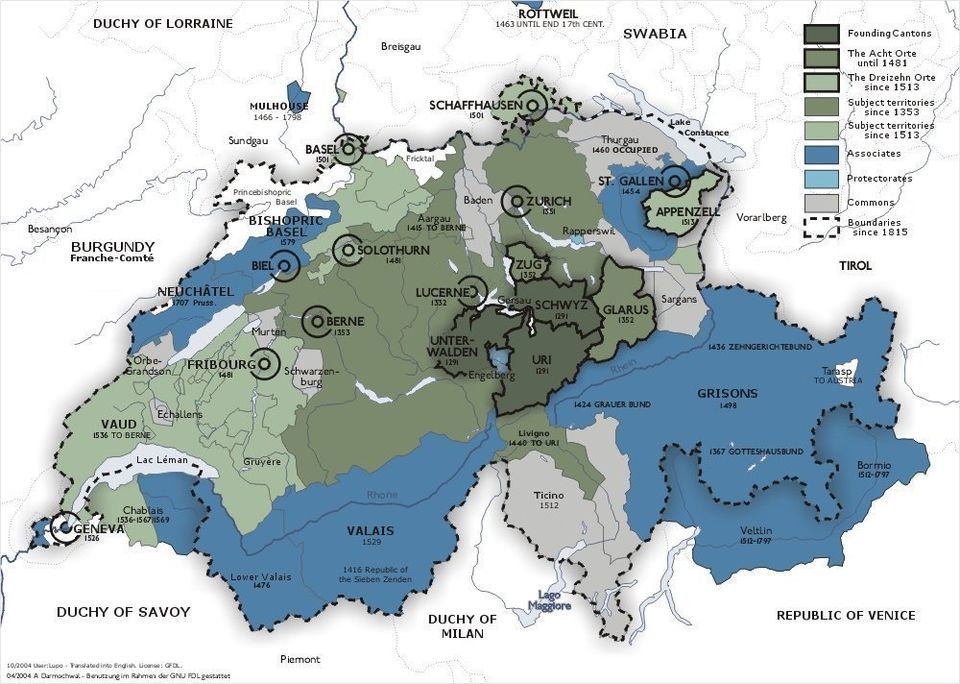 The Old Swiss Confederacy, from 1291 to the sixteenth century. Wikipedia.com
From Expansion to Neutrality
The Battle of Marignano in 1515 marked a significant shift in Swiss history. Facing French forces equipped with modern artillery, the Swiss suffered heavy losses. This defeat ended the Confederation’s expansionist ambitions and led to a policy of restraint. The subsequent “Eternal Peace” agreement with France established the foundations of Swiss neutrality—a principle that would become central to its identity.
Neutrality has since evolved into a defining aspect of Switzerland’s international role. It allows the country to host diplomatic negotiations, international organisations, and humanitarian efforts. Cities like Geneva have become global hubs for diplomacy, reinforcing Switzerland’s reputation as a neutral and reliable partner.
Managing Religious Divisions
At the same time, internal divisions emerged during the Reformation. Religious reformers such as Huldrych Zwingli and John Calvin introduced Protestantism, dividing the cantons along confessional lines. Despite tensions, Switzerland avoided prolonged internal conflict. A famous symbolic moment, the “Kappeler Milchsuppe,” tells of Catholic and Protestant soldiers sharing a meal instead of fighting—reflecting the Swiss preference for compromise.
This tradition of compromise continues to shape Swiss society. Political disagreements are often resolved through dialogue and incremental change rather than confrontation. For residents, this contributes to a stable environment where policy shifts tend to be gradual and predictable.
Neutrality Tested in a Turbulent Europe
The seventeenth century brought further challenges, particularly during the Thirty Years’ War. While much of Europe was devastated, Switzerland remained largely at peace. Through internal agreements and defensive coordination, the Confederation maintained its neutrality. This status was formally recognized in 1648 with the Peace of Westphalia, confirming Switzerland’s independence from the Holy Roman Empire.
The long-term effect of this period was the strengthening of Switzerland’s defensive mindset. Rather than relying on expansion or alliances, the country focused on internal cohesion and preparedness—principles that still underpin its national defence strategy.
Revolution and Rebalancing
This stability was disrupted in 1798, when French revolutionary forces invaded Switzerland and established the Helvetic Republic. This centralized system introduced reforms such as a unified currency and national citizenship, but it also sparked resistance due to the loss of local autonomy.
Napoleon’s Act of Mediation in 1803 restored a balance between central authority and cantonal independence. Following his defeat, the Congress of Vienna in 1815 reaffirmed Switzerland’s neutrality and re-established it as a confederation of 22 cantons.
These events reinforced a key lesson in Swiss political culture: that stability depends on respecting regional diversity. Attempts at excessive centralization have historically been met with resistance, shaping the cautious approach to reform that persists today.
The Birth of Modern Switzerland
Internal tensions resurfaced in the nineteenth century, culminating in the Sonderbund War of 1847. This short conflict was resolved quickly and with relatively few casualties under the leadership of General Guillaume Henri Dufour. His emphasis on restraint and humanity helped preserve unity.
The result was the 1848 Constitution, which transformed Switzerland into a modern federal state. This system successfully balanced regional autonomy with national governance and remains the foundation of Swiss political life today.
For people living in Switzerland, this federal system is highly visible. Local governments have real authority, and citizens are regularly called upon to vote on issues ranging from infrastructure to social policy. This participatory model fosters a strong sense of civic responsibility.
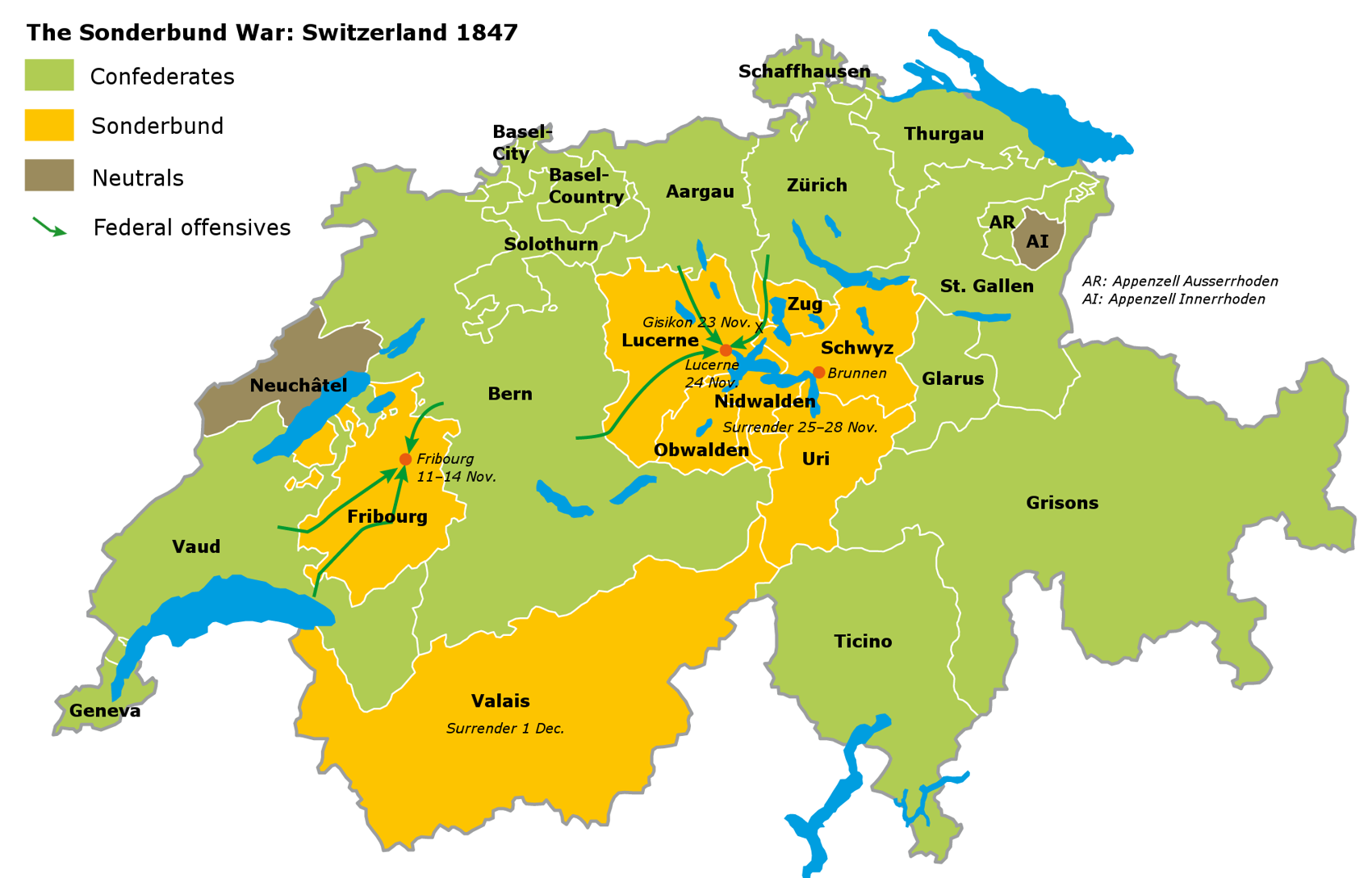 Map of the Sonderbund War in Switzerland 1847. Wikipedia.com
Industrial Growth and Social Change
The late nineteenth and early twentieth centuries brought rapid industrialization. Economic development led to social pressures, culminating in the General Strike of 1918. Workers demanded reforms such as a shorter workweek and greater political representation. While the strike was suppressed, many of its demands were later implemented, shaping modern Swiss society.
Today, Switzerland is known for its high standard of living, strong labour protections, and well-developed infrastructure. These features are the result of gradual reforms built on earlier social struggles, contributing to a stable and prosperous environment.
Survival During World War II
World War II posed a significant threat to Switzerland’s independence. Surrounded by Axis powers, the country prepared for invasion. General Henri Guisan developed the “National Redoubt” strategy, fortifying the Alps as a defensive stronghold. This approach, combined with diplomacy, helped Switzerland remain neutral and avoid occupation.
The legacy of this period is still visible today. Military service remains compulsory for many Swiss men, and civil defence infrastructure continues to reflect a culture of preparedness.
A Shared Identity in a Diverse Nation
Swiss identity has been reinforced through enduring symbols such as Helvetia, the national personification. Depicted on coins and stamps, she represents unity across linguistic and cultural divisions. In a country with multiple official languages, such symbols play a key role in fostering cohesion.
Beyond symbols, shared values—such as punctuality, reliability, and respect for rules—play an important role in everyday life. These cultural traits contribute to Switzerland’s reputation for efficiency and order.
 Markus Kammermann via Unsplash.com
Switzerland in the Modern World
In the twenty-first century, Switzerland continues to balance independence with international cooperation. Rather than joining the European Union, it has pursued a bilateral approach, negotiating agreements that allow access to European markets while maintaining sovereignty.
After setbacks in 2021, progress resumed with the “Bilaterals III” agreements in 2026. These cover areas such as energy, health, food safety, and research cooperation. They also include mechanisms to align regulations where necessary, without full political integration.
For residents and businesses, these agreements ensure continued access to European networks while preserving Switzerland’s distinct political system.
A Model of Stability and Pragmatism
The trajectory of the Swiss Confederation reveals a consistent pattern: adaptation without abandoning core principles. Switzerland has combined local autonomy with national unity, and economic integration with political independence.
Its model shows that diversity can be a strength when supported by inclusive institutions. Through compromise, decentralisation, and long-term thinking, Switzerland has built a stable and prosperous society.
In a rapidly changing world, the Swiss example offers valuable insights into how balance, cooperation, and resilience can shape not just a country’s history—but its everyday way of life.
Podcast episode
For more on these topics, please be sure to listen to this episode of our Living in Switzerland podcast. If there are any other topics you’d like us to cover, please email us at contact@rigby.ch to let us know.